
Glass and Facade Cleaning in Dubai: What to Agree Before Anyone Goes Up
Glass degrades faster in Dubai than most people expect. Humidity holds fine dust against the surface, sun exposure bakes it in, and salt carried inland leaves a haze that ordinary wiping only redistributes. By the end of summer, a building can be looking through a filter its occupants stopped noticing months ago. Sorting it out means agreeing three things before work starts, and only one of them is price.
Interior and exterior are different services
Interior glass covers windows from inside, partitions, balustrades, mirrors, shopfronts and display glazing. It is done with purified water systems and squeegee technique, and the measure of a good job is the absence of streaking and spotting once the surface dries fully. Exterior work above ground level is a different service with different equipment, different training and different insurance, and it should be quoted as such rather than folded into a general cleaning price.
Access method drives everything
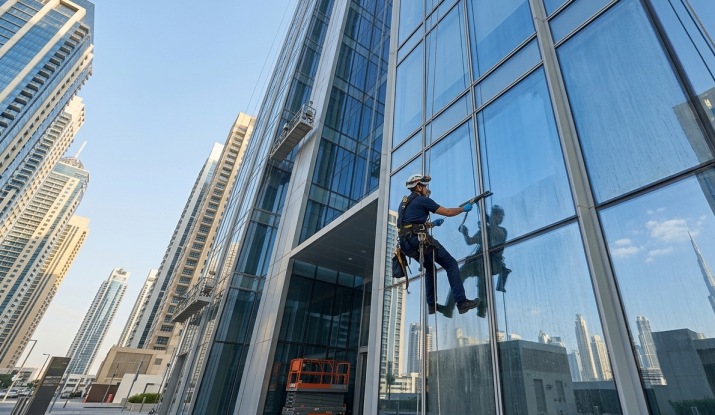
For low rise and villa work, ladders and water fed poles reach most surfaces safely. Mid rise usually needs a mobile elevating work platform, which in turn needs ground access, a level standing area and often a permit. High rise glazing and curtain walling is rope access or a building maintenance unit where the building has one installed. The access method determines the cost, the duration and the safety requirements, so it should be confirmed at survey rather than assumed. For residential properties with substantial exterior glazing, this often connects directly with villa deep cleaning.
Verify the safety credentials
This is not a formality on work at height. Ask for evidence of operative certification for the access method being used, a site specific risk assessment and method statement, third party liability insurance with the sum insured stated, and confirmation of workmen compensation cover. Any contractor working properly at height will have these ready. A contractor who does not is a liability that transfers to the building owner.
Building permissions
Most towers and managed developments require the contractor to be approved by building management before mobilisation, and rope access work often needs anchor point certification checked and a permit issued. Building this into the timeline avoids the common situation where the team arrives and cannot start.
Frequency
Exterior glass on a commercial tower is typically cleaned quarterly, with high exposure elevations more often. Villas and low rise properties do well twice a year, adjusted for proximity to construction or to the coast. Interior glass in an office or a showroom needs a much shorter cycle because it is touched. Retail frontage is usually weekly.
Timing it well
Booking exterior work as summer builds is more effective than waiting for it to end, because the deposits that bake onto glass in peak heat are harder to remove once they have been there for months. Peak season also fills up, which is a scheduling reality rather than a sales line.
Frequently asked questions
Do you clean glass on occupied buildings?
Yes. Work is scheduled around occupancy and access is coordinated with building management, with the affected areas cordoned at ground level while overhead work is in progress.
Will hard water spotting come off?
In most cases, with the correct treatment. Long term mineral etching that has damaged the glass surface itself cannot be cleaned off and needs restoration or replacement, and that should be identified during the survey.
Can you clean the facade as well as the glass?
Yes. Cladding, stone, aluminium composite and painted surfaces need different methods from glazing, so they are surveyed and quoted alongside rather than assumed to be included.
Arranging a survey
Our glass and facade cleaning page covers the access methods, safety documentation and service scope we work to, and a site survey produces a written proposal with the access method and permit requirements confirmed.