Warehouse Deep Cleaning Without Losing a Day of Throughput
In an office, accumulated dust is a presentation problem. In a warehouse it shows up as a fire load, a contamination risk, a machinery fault and a line on an audit report. Warehouse deep cleaning is a different discipline from commercial cleaning, and the planning matters as much as the work, because the constraint is almost never the cleaning itself. It is the operation that cannot stop. For facilities teams moving between site types, it helps to compare this with office deep cleaning.
Where the dust actually sits
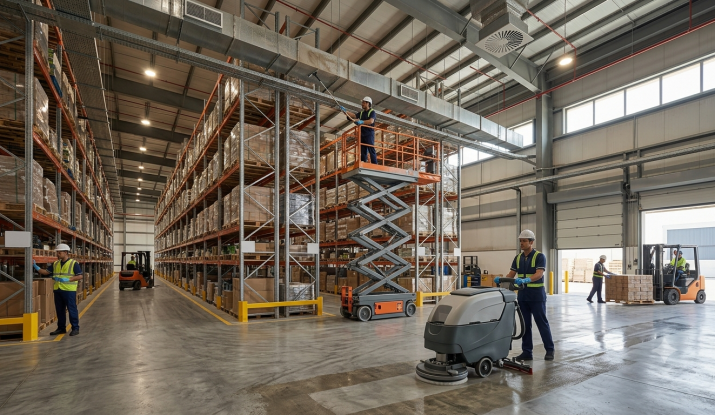
Above head height, mostly. Racking uprights and beams, structural steelwork, conduit and cable trays, ducting, extraction grilles and high level light fittings. This is the material that eventually falls onto stock and into machinery, and it is the part standard cleaning never touches because it needs access equipment and a team trained to work at height.
Floors are a separate scope
Forklift traffic leaves tyre marking and embedded soiling that mopping will not lift. Industrial scrubbing with the correct pad and solution is the method, and heavily contaminated areas may need degreasing first. Line marking condition should be assessed at the same time, since a floor that has just been scrubbed is the right moment to reinstate markings if they have worn.
The areas that fail audits
Loading bays and dock levellers where debris collects at the edges. Behind and beneath racking at floor level. Drainage channels and gullies. Waste and recycling areas. Welfare facilities, which are checked more often than people expect. Extraction and ventilation grilles. Listing these separately in the scope avoids the situation where the visible floor is spotless and the audit finding stands.
Planning around the operation
Most industrial deep cleaning is delivered during night shifts, weekend windows or planned shutdown periods, and it can also be phased zone by zone so only one section of the facility is out of use at a time. Phasing costs more in total labour hours and it usually costs less than stopping. Decide which of those you are optimising for before asking for a quote, because it changes the proposal substantially.
Documentation before mobilisation
A site specific method statement and risk assessment should be prepared and issued before work begins, covering working at height, equipment used, isolation requirements, protective equipment and emergency procedures. Confirm that operatives are trained for the access equipment being used and that third party liability cover is in place. If a provider treats this as paperwork to produce afterwards, that tells you how the job will run.
Frequency
Structural and high level dust removal is typically annual or biannual depending on the operation, with floor scrubbing on a much shorter cycle. Facilities handling food, pharmaceuticals or sensitive electronics work to their own defined intervals. Aligning the deep clean with the period before an audit or an insurance inspection is the practical scheduling decision most operations make.
Frequently asked questions
Can cleaning happen while we are operating?
Partially. Floor level work can often be phased around traffic. High level work requires the area beneath to be cleared and isolated, so that portion is normally scheduled during a shutdown or a quiet shift.
Do you clean around racking without unloading it?
Yes in most cases. Beams and uprights can be cleaned with stock in place. Where stock must be moved to reach a section safely, that is identified during the site survey rather than on the day.
What documentation do you provide?
A method statement, a risk assessment, insurance certification and a completion report. For audit purposes, request the completion report to reference the specific zones and tasks covered.
Arranging a site survey
Our warehouse and industrial cleaning page sets out the scope areas and access methods, and a site survey produces a written scope, method statement and quotation you can put in front of an auditor. For mixed estates, readers can also move into building cleaning or the broader office and commercial cleaning service.