
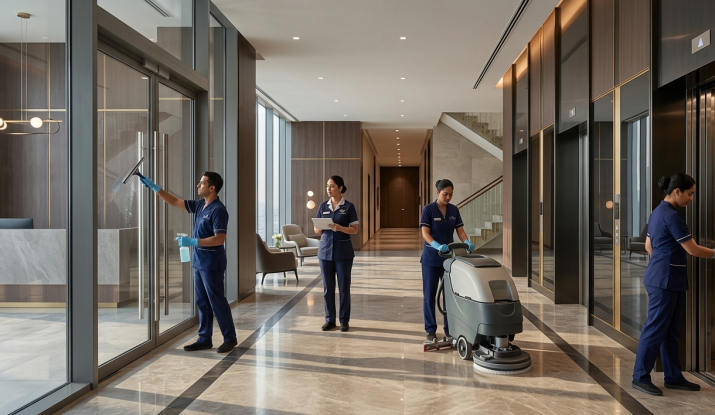
Building Cleaning: How to Write a Scope of Work Your Residents Will Actually Notice
Residents form their opinion of a building in the lobby and the lift, not in their own apartment. Those are also the areas most likely to be covered by an informal arrangement with no written standard, which means complaints arrive with no way to evidence what was or was not done. A building cleaning service works when the scope, the frequency and the reporting are all written down.
Specify by zone and frequency together
A scope that lists areas without frequencies is not a scope. Entrance and lobby, usually multiple times daily. Lift interiors, cars and door tracks, daily with a weekly deep clean. Corridors and lift lobbies on each floor, daily or on a defined rotation depending on the number of floors. Staircases and fire escapes, weekly at minimum with a documented monthly deep clean. Refuse rooms and chutes, daily with a scheduled sanitisation cycle. Parking levels, swept on a defined rotation with periodic pressure washing. Common area glass and balustrades, weekly. High level dusting on a quarterly cycle. Where common area glass becomes a specialist access task, link to glass and facade cleaning.
Name the standard, not just the task
There is a difference between sweeping a parking level and pressure washing it, and between wiping a lift and treating the door tracks where the dirt actually collects. Where a task has a method attached, write the method. Where a finish is expected, describe it. This is what stops the standard drifting downward across a twelve month contract.
Staffing and supervision
Ask whether staff are assigned to your site or rotated across several. Teams that stay learn the building, which lift needs the most attention on a Monday, which entrance takes the sand, which corridor holds the smell from the refuse room. Ask who supervises, how often the supervisor attends, and whether inspections are recorded.
Reporting is what protects the committee
This is the part most contracts leave out and most committees later wish they had. Agree the reporting format up front. A monthly report showing attendance, completed periodic tasks, inspection outcomes, incidents and any areas needing attention gives a management committee something to present. Without it, every discussion becomes a matter of opinion.
Consumables, waste and equipment
State clearly who supplies washroom consumables for common area facilities, who removes waste and to what schedule, and whether machines and equipment are provided by the contractor. These items are small individually and they are the source of most mid contract disputes.
Contract structure
Annual contracts with a defined notice period are standard, and a short initial review point in the first quarter is worth including. It gives both sides a structured moment to adjust frequencies once real usage patterns are visible, rather than either living with a scope that does not fit or terminating early.
Frequently asked questions
How many cleaners does a residential tower need?
It depends on floor count, occupancy and the number of entrances and lift cores rather than on a fixed ratio. A site visit produces a realistic figure. Be cautious of any proposal that arrives without one.
Can cleaning be scheduled around resident movement?
Yes. Heavy tasks in lobbies and parking levels are usually scheduled early morning or late evening to avoid peak movement, and this should be written into the schedule rather than left to the team on site.
What happens if standards slip?
A contract should include an inspection regime and a defined escalation process. Recorded inspections turn a subjective complaint into a documented issue with a remedy period attached.
Requesting a scope and proposal
Our building and common area cleaning page covers the zones, frequencies and reporting we work to under contract, and a site visit produces a written scope of work and proposal for your committee to review. If the same property also includes offices or back of house areas, add a route into office deep cleaning or warehouse deep cleaning.